

6 must-have CRM features for omnichannel healthcare marketing

Generic email blasts and mistimed reminders reveal systems that weren't built for healthcare's complexity. These six CRM features separate platforms that manage contacts from those that orchestrate meaningful patient engagement.
The patient who searched for a specialist on your website yesterday received a generic email campaign today promoting services they already booked. Another patient who just completed their annual wellness visit gets an automated reminder to schedule that same appointment.
These aren't isolated glitches; they're symptoms of a fundamental problem. Most healthcare organizations are running marketing operations on systems never designed for the complexity of patient engagement.
The result is a patient experience that feels disconnected at best and tone-deaf at worst. Marketing teams work tirelessly to create compelling campaigns, yet the technology underneath can't deliver the context-aware, individually relevant communications that modern healthcare consumers expect.
Here are the six essential capabilities your healthcare CRM platform must deliver to transform fragmented campaigns into coordinated care journeys.
1. deep EMR integration that goes beyond basic data sync
Generic CRMs pull contact information. Healthcare CRM platforms need to do significantly more. The most effective healthcare marketing automation starts with secure, bidirectional connections to your Electronic Medical Records that provide real context for every patient interaction. This means accessing appointment history, care plan details, chronic condition management, and health status indicators- all the clinical intelligence that separates relevant outreach from noise.
The integration enables healthcare marketers to move beyond broad demographic targeting toward precision engagement that actually supports clinical goals. When your CRM for healthcare marketing understands not just who your patients are but where they are in their health journey, every communication becomes an opportunity to guide them toward better outcomes.

2. consumer 360 views that unify every data point
Demographic information sits in one system. Behavioral data lives in another. Clinical records exist in a third. This data fragmentation creates blind spots that make personalization impossible.
An effectively optimized healthcare CRM system is a Consumer Data Platform (CDP), in which all sources of information- EMRs, appointment systems, websites, mobile applications, billing systems, and patient portals- share information into a single, actionable profile.
This holistic perspective captures clinical data and demographic data, behavioral trends, history of engagement, and preferences in communication. Not only does the outcome increase the amount of data, but more valuable context that will change the way your team interacts with patients.
3. intelligent journey builder for coordinated multi-channel campaigns
Sending emails is easy. Orchestrating coordinated experiences across email, SMS, phone, portal, and direct mail that adapt based on patient behavior- that requires sophisticated healthcare marketing software.
The best patient communication platforms include journey builder capabilities that allow marketing teams to design complex, multi-step campaigns with conditional logic, automated triggers, and channel optimization. This means moving from reactive, one-off communications to proactive engagement sequences that guide patients through their entire care experience.
4. omnichannel coordination that maintains context across every touchpoint
Multi-channel marketing sends messages through multiple channels. Omnichannel healthcare marketing ensures those channels work together intelligently. The distinction matters enormously. In multi-channel approaches, your email campaigns don't know what your SMS campaigns are sending. Your portal notifications operate independently of your direct mail efforts.
True omnichannel coordination means every channel has visibility into what's happening across all other channels. When a patient responds to an email, your SMS campaigns adjust accordingly. When they schedule an appointment through the portal, subsequent marketing communications reflect that action. When they engage with educational content on your website, your next email builds on that interest.
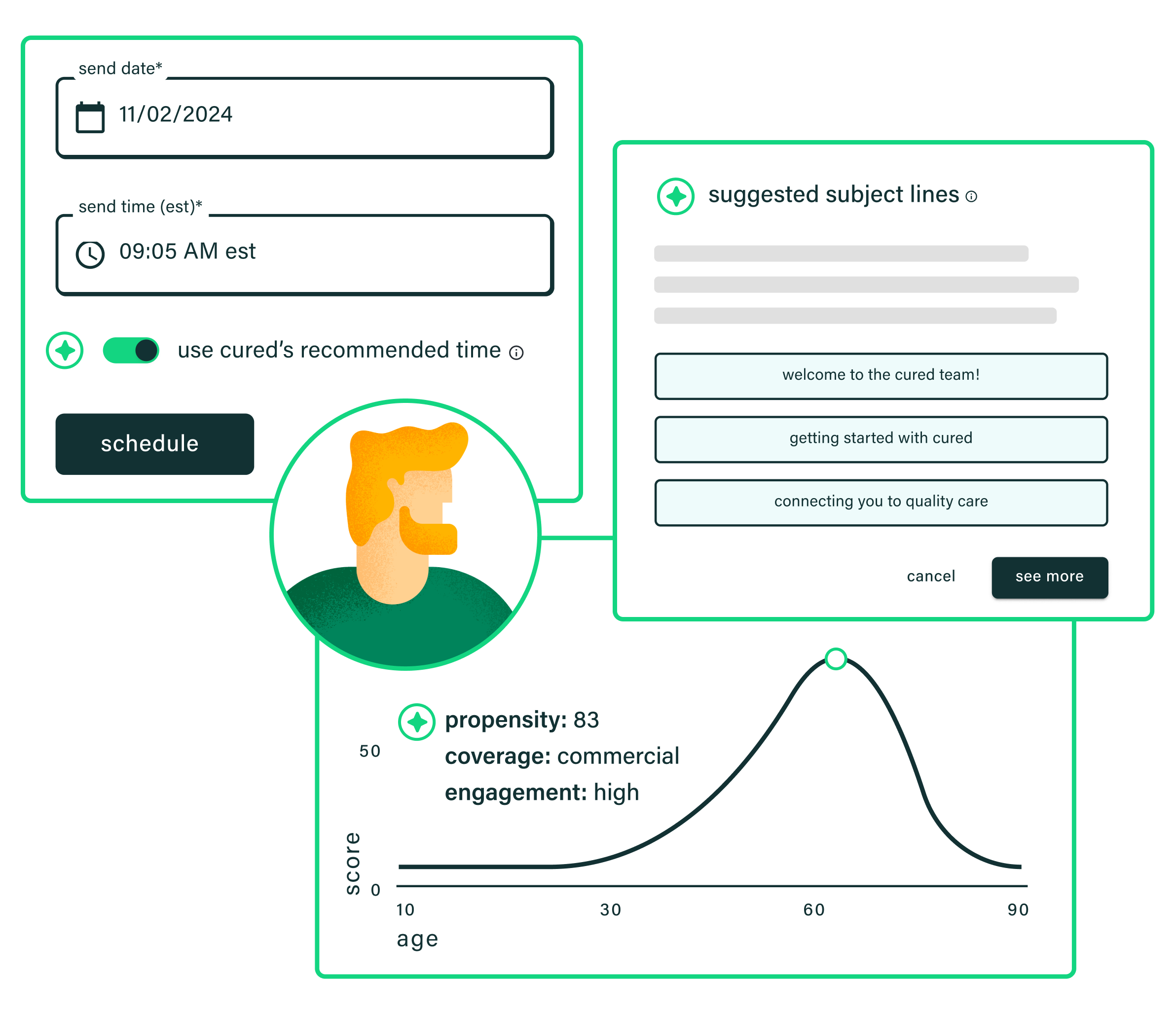
5. AI-powered personalization that scales individual attention
Manually personalizing outreach for thousands of patients isn't realistic. That's where artificial intelligence transforms healthcare CRM software from a database into a strategic advantage.
Top healthcare marketing platforms use AI to interpret the behavioral patterns of patients, customize the likelihood of engagement, spamming optimal send times, content suggestions, and reliably issue content variants at scale. It is not the substitution of human judgment, but an amplification of your team, in order to provide the individual care of small groups of patients, to large-scale populations.
6. comprehensive analytics that connect marketing to outcomes
Healthcare marketing teams are increasingly expected to prove ROI and demonstrate how engagement initiatives impact clinical outcomes. Your patient engagement CRM needs analytics that go far beyond open rates and click-through metrics.
The most sophisticated healthcare CRM platforms connect marketing activities to downstream results: appointment conversions, care plan adherence, screening completion rates, patient retention, and ultimately, health outcomes. This requires integration with clinical systems that can attribute patient actions back to specific marketing touchpoints.
cured: transforming fragmented outreach into coordinated care
The right healthcare CRM software doesn't just organize data; it changes how your organization engages patients. Through networked information consolidation, coordinated channel experiences, and intelligence to scale to personalization, the modern healthcare CRM platforms can enable patient-centered marketing that the modern consumer requires and deserves.
In considering healthcare marketing software, the features are secondary, but not the results. It is not about whether a platform can be a journey builder or whether it can do AI-based personalization: it is about whether those capabilities will actually enable you to send more relevant, effective, and timely patient communication that can enhance engagement, increase loyalty, and help achieve better health outcomes.

